
How We Design, Test, and Manufacture Handsling Frames
Every bike brand claims their frames are revolutionary, ultralight, or market-defining. Most of that comes out of a marketing department. At Handsling, we do things differently—not to be deliberately contrary, but because we build bikes to be ridden hard, in the real world, for years on end.
Here is how a Handsling frame actually moves from a CAD drawing on an engineer’s screen to a custom-built bike leaving our Oakhanger workshop.
Defining the Balance: Speed Without the Punishment

The real engineering challenge, however, is achieving the right structural balance. It has to be stiff enough through the head tube, down tube, bottom bracket shell, and chainstays to ensure every watt of pedalling input translates directly into forward motion without energy loss. That gives a racer the explosive power transfer needed to win a sprint.
At the same time, we have to engineer real-world compliance. If a frame beats you up over a 120- or 150-mile ride, it has failed. By carefully tuning the layup of the seat tube and running relatively flexible seatstays, we get a frame that absorbs road buzz over long distances while remaining razor-sharp when you put the hammer down.
In that way, we create a frame that gets a racer to the finish feeling fresher, ready to win that sprint to the line. But also it suits older riders who want something that isn't going to batter them. Indeed, though I remember my racing days fondly, I’m no spring chicken anymore; nowadays, I’m the slightly overweight, middle-aged chap wanting to coast around the Hampshire lanes at a 16 mph average, so I build frames that suit both types of rider. They are capable of winning races but also offer plenty of comfort.

2. Structural Engineering Over Paper Weight Targets

We mix different grades of carbon fibre—such as Toray T1100—and alter ply orientation depending on the frame's specific zone:
- High-Stress, High-Stiffness Zones: The head tube, down tube, and bottom bracket use stiffer, highly durable carbon layups to resist torsional flex under load.
- Compliance Zones: The seat tube and stays use a different blend and thinner orientation to allow controlled micro-flex for comfort.
Modern high-modulus carbons like T1100 allow you to achieve incredible stiffness using less material, which makes for a lighter frame. However, we always prioritise durability and predictable handling over chasing the absolute lowest weight. We over-engineer our frames because I simply refuse to design bikes that come back to us with structural failures as a matter of course.
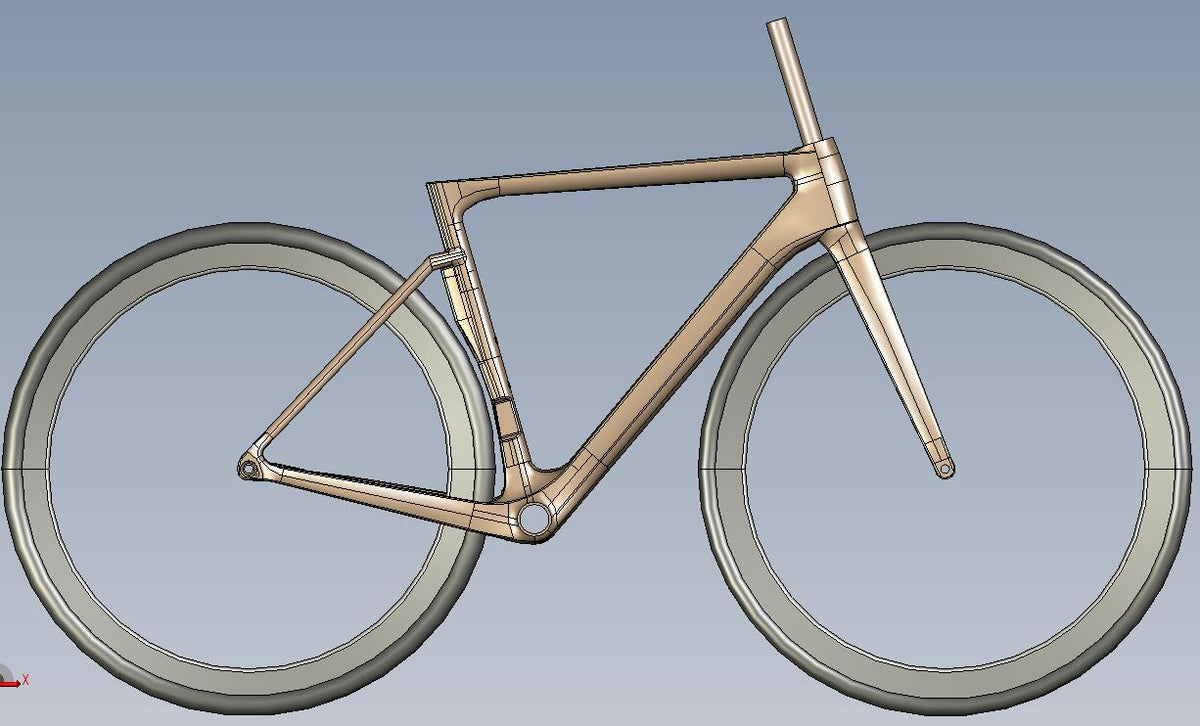
Handsling A1R0evo CAD File
3. Factory Destructive Testing and UK Real-World Abuse
Before a new design goes into full production, it goes through a brutal validation process. We make all our initial prototyping moulds in a size 52cm, simply because that’s my size.
A1R0evo mould

The first two frames out of the mould never see a road. Instead, they are put through a suite of 7 to 8 factory testing rigs in Shenzhen and tested to destruction:
- Cyclic Fatigue Testing: Millions of high-load cycles applied across the bottom bracket and head tube to simulate years of heavy use.
- Ultimate Load Testing: Pushing the frame structure past ISO industry targets to locate its exact failure limits.
Once those first two frames are sacrificed to verify structural safety, frame number three is shipped directly to our UK workshop for real-world testing.


4. Single-Factory Control and Advanced EPS Moulding
Early in Handsling’s history, we used different suppliers for frames and wheels. Managing multiple factories created quality control headaches and limited our ability to refine the manufacturing process.
Today, we work exclusively with one partner factory owned by our lead engineer. We don't shop around for cheap production runs. This tight, long-term relationship gives us total oversight of quality and allows us to implement manufacturing advancements rapidly.
Over the years, we have updated our frame moulding process through three distinct generations:
- Firstly we use standard internal bladders.
- Then we moved over to expanded polystyrene (EPS) inner moulds.
- Now we are using rubber-wrapped EPS inner moulds to gain maximum carbon compaction.
A1R0evo EPS Internal Moulds


This strict quality focus is also why we stand by specific bottom bracket standards:
- Road Frames (BB86): We refuse to take the easy option of installing alloy sleeves or threaded inserts on our high performance road frames like the A1R0evo. We spend the extra time and effort ensuring our full-carbon BB86 bottom bracket shells are moulded 100% round for peak power transfer and creak-free press-fit tolerances.
- Gravel, Cyclocross, and Track (BSA / T47): On frames like the A1R0evoG or CEXevo, mud exposure and frequent servicing mean threaded BSA or T47 options make far more practical sense for the rider.
5. Iteration Over Artificial Model Cycles
We don't subscribe to the mass-market trend of releasing a completely redesigned frame every two years just to force customer upgrades. We invest our time into getting a single design right, and then refine it continuously over its lifespan.
A prime example of this iteration is our CEXevo cyclocross frame. We wanted an integrated front end and as we were never completely satisfied with the original front-end handling, we redesigned the fork geometry increasing the fork rake slightly. That subtle shift lengthened the wheelbase, giving the bike far more composed, predictable handling and stability. This new fork can be retro-fitted to any CEXevo, no matter when it was bought from us.
Similarly, on the TR2evo track sprint frame, tight UCI dimensional constraints required us to re-engineer the fork blades to keeping the frame fully race-legal, but while we were at it, we deepened the blades considerably to extract maximum aerodynamic speed.
Because our core geometries are built to endure, we make retrofittable upgrades available—such as our updated integrated aero road forks for the A1R0evo and A1R0evoS—so owners of older frames can easily update their existing setup without needing an entirely new bike.
6. UK Prep, Hand-Painting, and Bespoke Assembly
When raw carbon frames arrive at our UK facility in Hampshire, every single bike is hand-finished to order:
Surface Prep: Raw frames go into our UK prep room, sitting on downdraft extraction benches, so our paint team technicians can meticulously inspect, sand, and smooth the raw carbon surfaces.
Handsling prep room with extraction benches

Multi-Layer Custom Paint: After initial prepping, the paint team are in Handsling's custom, made to measure paint booth to apply primer. They will then sand that back. Next they lay down the chosen custom base colour and sand that back. A layer of top coat (lacquer) is applied before they apply the logos. After another sanding, we seal everything under a final, protective topcoat, matt or gloss. It’s an involved, multi-stage process that ensures a durable finish that stands up to stone chips and road grit.
Handsling paint booth
Precision Workshop Build: Once out of the paint booth, our workshop technicians take over. They aren't just assembly mechanics; they understand frame tolerances inside out. They cross-reference the customer’s exact bike fit dimensions (taken at the time of order) to ensure correct handlebar reach, stack height, crank length, and saddle position before a single cable is routed.
A Handsling TSTRevo being built in the workshop
The Bottom Line
When you swing a leg over a Handsling, you are riding a bike that was built specifically for you—engineered to win sprints, durable enough to handle years of abuse, and, where appropriate, comfortable enough for the longest days in the saddle.
Finished frames being prepped for shipping


Leave a comment
This site is protected by hCaptcha and the hCaptcha Privacy Policy and Terms of Service apply.